
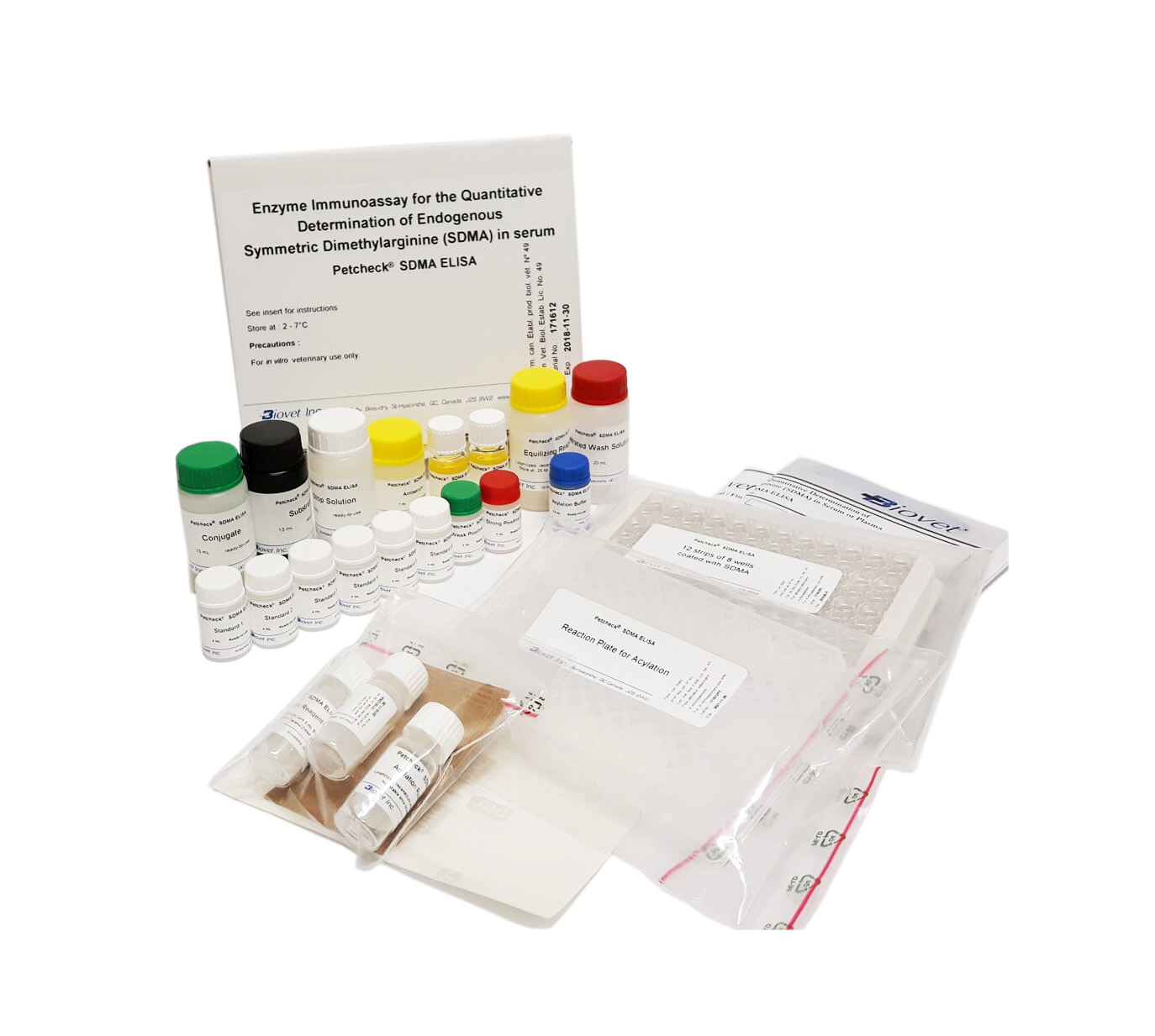
PetCheck SDMA
Kit for the determination of SDMA (Symmetric Dimethylarginine)
Petchek SDMA is based on the ELISA enzyme immunoassay technique for the determination of SDMA in dog or cat serum or plasma.
The introduction of the quantitative determination of SDMA (Symmetric Dimethylarginine), now widely available through the PetCheck SDMA ELISA test, represented a major innovation in veterinary nephrology.
Measuring SDMA is not limited to integrating an additional biomarker into the biochemical profile; it reflects an evolution in the diagnostic approach, shifting clinical practice from the sole identification of advanced kidney disease to the early recognition of reduced renal function and the implementation of targeted nephroprotective strategies.
Below is a detailed analysis of the pathophysiological mechanisms that make the SDMA ELISA test an essential clinical advantage for veterinarians, moving away from the classic description of a "renal marker."
1.Emancipation from Muscle Mass: Intranuclear Origin
The main limitation in interpreting creatinine lies in its metabolic origin in muscle, as it derives from the catabolism of creatine present in skeletal muscle tissue. This characteristic poses a significant diagnostic challenge: an older cat with advanced Chronic Kidney Disease (CKD) but characterized by marked loss of muscle mass (sarcopenia or cachexia) may have apparently normal serum creatinine concentrations despite a significant reduction in glomerular filtration rate, as the reduced availability of muscle tissue leads to lower endogenous production of the biomarker.
- Ubiquitous origin and epigenetic regulation: SDMA has a biological origin distinct from muscle-derived biomarkers. It arises from the post-translational methylation of arginine residues in nuclear proteins, a process catalyzed by enzymes belonging to the PRMT (Protein Arginine Methyltransferase) family.
- Diagnostic relevance: Since protein turnover constantly affects all nucleated cells in the body, endogenous production of SDMA is highly stable and poorly influenced by changes in body composition. ELISA determination therefore allows for the evaluation of a biomarker independent of muscle mass, age, and nutritional status; in cats, it is also less affected by hyperthyroidism, a condition that can mask CKD through increased glomerular filtration and reduced muscle mass. Therefore, elevated SDMA concentrations in a subject with marked sarcopenia may indicate impaired renal function even in the presence of apparently unchanged creatinine values.
2.Compensatory Hyperfiltration: Why Creatinine May Not Be Sufficient
The kidneys of dogs and cats possess a high capacity for functional compensation. In the presence of progressive nephron loss, due for example to tubulointerstitial nephritis or glomerular disease, the residual nephrons increase their filtering activity through a mechanism known as compensatory hyperfiltration. This adaptation allows apparently normal renal function to be maintained even in the presence of already significant damage.
- Diagnostic Creatinine Limits: Serum creatinine concentration is a well-established indicator of renal function, but its sensitivity is limited in the early stages of the disease. Due to compensatory hyperfiltration, creatinine values can remain within the reference range until approximately 75% of functional nephron mass is already compromised. Consequently, an increase in creatinine often reflects advanced stages of chronic kidney disease (CKD), when the margin for therapeutic intervention is already limited.
- SDMA as an early biomarker of glomerular function: SDMA is a biomarker closely related to glomerular filtration rate (GFR). Because it is eliminated almost exclusively by glomerular filtration, with negligible tubular reabsorption, SDMA reflects changes in renal function more directly than creatinine. Clinical studies demonstrate that SDMA levels exceed the cutoff (typically >18 µg/dL) even in the presence of a 25% to 40% reduction in renal function, allowing CKD to be identified months, and in some cases years, before an increase in serum creatinine is observed. Quantitative measurement by ELISA therefore represents a highly valuable diagnostic tool for early diagnosis and the timely initiation of targeted therapeutic strategies.
3.SDMA: A Possible Player in CKD Progression
The latest scientific evidence suggests that SDMA may not be solely a passive indicator of reduced renal function. The accumulation of dimethylarginines, including both Asymmetric Dimethylarginine (ADMA) and, to varying degrees, SDMA, may directly contribute to the pathophysiological mechanisms of chronic kidney disease.
- Endothelial dysfunction and reduced nitric oxide bioavailability: Elevated circulating concentrations of SDMA may interfere with L-arginine metabolism, indirectly affecting nitric oxide (NO) synthesis by the vascular endothelium. Reduced NO availability leads to impaired endothelial function, resulting in increased vascular tone.
- A possible mechanism of disease progression: Systemic and intraglomerular vasoconstriction may promote the development of arterial hypertension and contribute to the progression of renal damage, establishing a vicious cycle that accelerates nephron loss and increases the risk of damage to target organs, such as the retina, heart, and central nervous system. Although further studies are needed to fully define the pathogenic role of SDMA, its early monitoring can provide valuable clinical information in the management of patients with kidney disease.
4.SDMA and IRIS guidelines: a new approach to CKD staging
The introduction of SDMA into clinical practice has led to an update of the International Renal Interest Society (IRIS) recommendations for the diagnosis and staging of chronic kidney disease in dogs and cats.
- The operational context: The integration of SDMA with traditional biochemical parameters allows for a more accurate classification of patients in the early stages of the disease. For example, an animal with creatinine still within the reference range but persistently elevated SDMA values (>18 µg/dL) may be identified as having more advanced renal impairment than the creatinine level alone would suggest. This early identification allows the veterinarian to promptly implement targeted therapeutic and management strategies, such as reviewing potentially nephrotoxic therapies, introducing an appropriate renal diet, monitoring blood pressure, assessing proteinuria, and closer clinical follow-up. The use of a quantitative ELISA test for SDMA measurement therefore represents an important support for preventive veterinary medicine, promoting early diagnosis and clinical intervention aimed at slowing the progression of chronic kidney disease.
Main Bibliography
- Nabity, M.B., et al. (2015) Symmetric dimethylarginine assay validation, stability, and evaluation as a marker for the early detection of chronic kidney disease in dogs. Journal of Veterinary Internal Medicine. 29(4):1036-1044.
- Hall, J.A., et al. (2014) Comparison of serum concentrations of symmetric dimethylarginine and creatinine as kidney function biomarkers in cats with chronic kidney disease. Journal of Veterinary Internal Medicine. 28(6):1676-1683.
- Hall, J.A., et al. (2015). Relationship between lean body mass and serum renal biomarkers in healthy dogs. journal of veterinary internal medicine.29(3):808-814.
- Peterson, M.E., et al. (2018) Evaluation of serum symmetric dimethylarginine concentration as a marker for masked chronic kidney disease in cats with hyperthyroidism. Journal of Veterinary Internal Medicine. 32(1):295-304.
- Kielstein, J.T., et al. (2006) Symmetric Dimethylarginine (SDMA) as Endogenous Marker of Renal Function—A Meta-analysis. Nephrology Dialysis Transplantation. 21(9):2446-2451.
SDMA, symmetrical dimethylarginine, is an amino acid that can occur in the plasma and is now an index used as a biomarker of renal function. A high SDMA value indicates the existence of ongoing renal failure.
The reference ranges for dogs and cats are as follows:
- Cat: 0 to 0.84 μmol / L
- Dog: 0 to 0.7 μmol / L
.
Persistent high levels of SDMA indicate decreased renal function. SDMA values should always be evaluated in conjunction with creatinine and other urinary parameters, especially urine specific gravity.

