
FOB IC
RAPID TEST BASED ON DUAL-TARGET TECHNOLOGY.
Simultaneous detection of fecal hemoglobin and erythrocytes in the feces of dogs and cats
GASTROENTEROLOGY
ADVANCED GASTROINTESTINAL DIAGNOSTICS FOR DOGS AND CATS
Rapid, reliable, and non-invasive tests, performed right in the doctor's office
Early diagnosis of gastrointestinal (GI) disorders is a key element for a preventive clinical approach and effective therapeutic patient management.
Although traditional diagnostic methods often rely on invasive or potentially stressful procedures, recent advances in veterinary diagnostics now allow for the collection of clinically relevant information through the use of highly specific, non-invasive fecal biomarkers.
Agrolabo supports this diagnostic approach with two innovative solutions: GIQuest, for the determination of fecal calprotectin, and FOB IC, for the detection of fecal hemoglobin (FOB) and intact red blood cells in the stool. Using both tests together provides objective data on the inflammatory status of the intestinal mucosa and the presence of gastrointestinal bleeding, facilitating earlier diagnosis, timely clinical decision-making, and optimized patient management.
By integrating clinically relevant fecal biomarkers with rapid, in-clinic tests, GIQuest and FOB IC assist veterinarians in the early identification of gastrointestinal disorders, the monitoring of intestinal health, and the guidance of diagnostic and therapeutic pathways—all while reducing the need for invasive and stressful diagnostic procedures for the patient.
WHY INTEGRATE THE TWO TESTS INTO VETERINARY CLINICAL PRACTICE?
The combined use of GIQuest and FOB IC allows for a rapid, comprehensive, and scientifically validated assessment of the health status of the gastrointestinal tract in dogs and cats..
- Quick confirmation during the medical examination
GIQuest and FOB IC make it possible to identify intestinal inflammation and active gastrointestinal bleeding in just 10–15 minutes, right in the doctor's office. - Optimization of the diagnostic pathway
When biomarkers and test results are within the normal range, GIQuest and FOB IC help reduce the use of unnecessary, high-cost, and invasive diagnostic procedures. - Monitoring of clinical response
GIQuest and FOB IC allow for an accurate and reproducible assessment, over time, of a patient's response to therapeutic treatments, nutritional interventions, and pharmacological therapies.
The presence of occult blood in the stool is often one of the first indicators of clinically significant gastrointestinal conditions, including ulcers (frequently associated with the administration of NSAIDs), parasitic infections, inflammatory bowel disease (IBD), and neoplasms of the gastrointestinal tract.
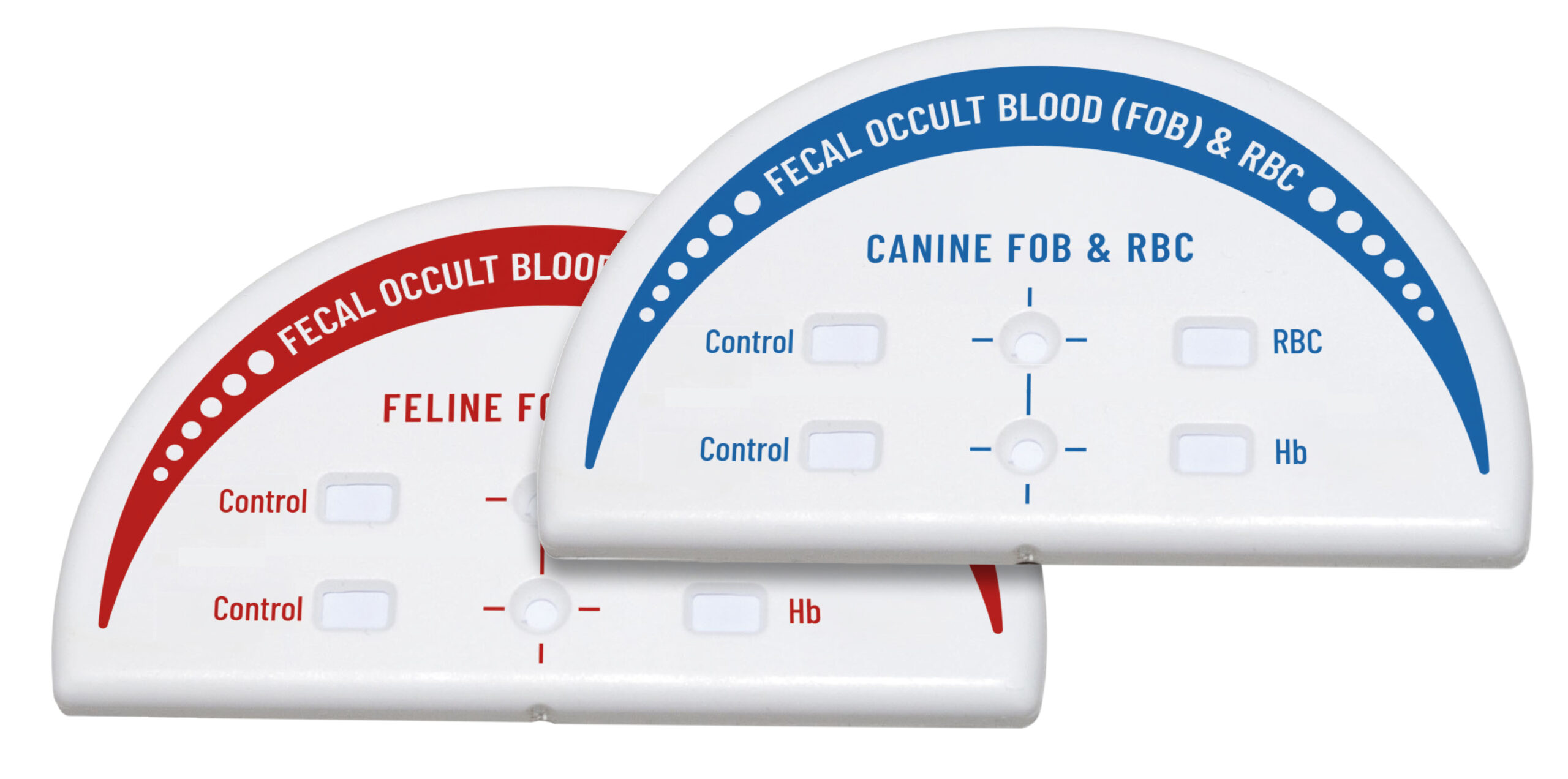
FOB IC, a product by Agrolabo, utilizes innovative Dual-Target technology to simultaneously detect free hemoglobin (Hb) and intact erythrocytes (RBC) in fecal samples from dogs and cats. This provides valuable insights into the potential origin of gastrointestinal bleeding, assisting the veterinarian throughout the diagnostic process.
FOB IC combines high analytical accuracy, ease of use, and reliability, making it the best choice for the detection of occult blood and red blood cells in fecal samples.
The Clinical Importance of Dual Detection
Unlike conventional tests, which detect only free hemoglobin, FOB IC incorporates an innovative dual-strip structure designed for the simultaneous detection of two independent biomarkers:
- Strip #1: Free hemoglobin. A positive result indicates the presence of chronic hemorrhage or bleeding in the proximal gastrointestinal tract. In this case, hemoglobin is released as a result of the breakdown of erythrocytes during the digestive process.
- Strip #2: Intact erythrocytes.A positive result indicates active, recent bleeding in the distal gastrointestinal tract, where the red blood cells remain intact.
.
Intact Red Blood Cells (RBCs)
Indicative of active or recent bleeding in the distal tract (colon, rectum). The red blood cells have not been degraded by digestive processes.
Free hemoglobin (Hb)
This indicates the presence of chronic hemorrhage or bleeding in the proximal tract. The red blood cells have been broken down by digestive processes.
Compared to the traditional guaiac-based test (gFOBT), FOB IC offers a more advanced diagnostic approach for the detection of fecal occult blood..
- Advanced technology and greater specificity. A highly specific immunochromatographic method based on antigen-antibody interaction, as opposed to the pseudo-peroxidase chemical reaction used in the guaiac test.
- Comprehensive detection of gastrointestinal bleeding. The dual detection of free hemoglobin and intact erythrocytes in the FOB IC test allows for a more in-depth assessment of the source of bleeding.
- No dietary restrictions. Unlike the guaiac test, which can yield false-positive results due to the consumption of certain foods (such as meat or specific vegetables), the FOB IC test requires no dietary restrictions, making the diagnostic procedure simpler and more convenient..
- Greater analytical specificity. In the FOB IC test, the monoclonal antibodies used ensure high analytical specificity, minimizing false-positive results related to diet..
Simple procedure. The FOB IC test allows for analysis on both strips using the same pipette, making the test quick, practical, and easily integrated into clinical routine.
.
| Characteristic | Traditional guaiac-based test (gFOBT) | FOB IC Agrolabo |
| Method | Pseudo-peroxidase chemical reaction | Immunochromatographic (antigen-antibody reaction) |
| Target | Free hemoglobin only (heme group) | Free hemoglobin + intact RBCs |
| Dietary restriction | Mandatory | None |
| Specificity | Poor (false positives due to diet) | Highly specific monoclonal antibodies |
.
CLINICAL BENEFITS
- No dietary restrictions
- Non-invasive: the collection and analysis of samples are carried out without causing stress to the animal
- Rapid protocol suitable for clinical settings: a procedure that can be easily performed in just 10–15 minutes
- High sensitivity and specificity in both canine and feline samples, eliminating false-positive cases
- Practical storage: the kit should be stored at room temperature (+18–25 °C)
| Format | 5 and 10 tests |
| Method | Immunochromatographic assay |
| Target | Intact canine and feline hemoglobin and red blood cells |
| Species | Dog and Cat |
| Samples | Feces |
| Components | Specific monoclonal antibodies against hemoglobin and red blood cells |
| Results | Visual reading |
| Sensitivity (Hb) | 100% – 1 μg/mL (Dog); 8 μg/mL (Cat) |
| Sensitivity (RBC) | 100% – 107 – 108 RBC/mL |
| Specificity | 100% |
| Validity (Expiry date) | 18 months |
| Storage | Room temperature (+18-25 °C) |
| Usage | For professional veterinary use only |
- Aadland, E., Fagerhol, M.K., 2002. Faecal calprotectin: a marker of inflammation throughout the intestinal tract. J. Gastroenterol. Hepatol. 14, 823-825.
- Chappell,, Van Vertloo, L., Viall, A., Scaccianoce, J., LeVine, D.N., 2024. Rectally obtained fecal samples can be used for fecal occult blood testing in dogs, and fecal immunochemical tests do not detect canine or feline blood. Am. J. Vet. Res. 1-7.
- Däbritz, J., Musci, J., Foell, D., 2014. Diagnostic utility of faecal biomarkers in patients with irritable bowel syndrome. World J. Gastroenterol. 20, 363-375.
- El-Zahar, H., El-Rahman, Z., El-Naggar, A., 2022. Fecal calprotectin concentrations and other indicators in dogs with idiopathic inflammatory bowel disease. Anim. Health Prod. 10, 88-96.
- Grellet, A., Heilmann, R.M., Lecoindre, P., Feugier, A., Day, M.J., Peeters, D., Freiche, V., Hernandez, J., Grandjean, D., Suchodolski, J.S., Steiner, J.M., 2013. Fecal calprotectin concentrations in adult dogs with chronic diarrhea. Am. J. Vet. Res. 74, 706-711.
- Heilmann, R.M., Suchodolski, J.S., Steiner, J.M., 2008. Development and analytic validation of a radioimmunoassay for the quantification of canine calprotectin in serum and feces from dogs. J. Vet. Res. 69, 845-853.
- Heilmann, R.M., Jergens, A.E., Ackermann, M.R., Barr, J.W., Suchodolski, J.S., Steiner, J.M., 2012. Serum calprotectin concentrations in dogs with idiopathic inflammatory bowel disease. J. Vet. Res. 73, 1900-1907.
- Heilmann, R.M., Berghoff, N., Mansell, J., Grützner, N., Parnell, N.K., Gurtner, C., Suchodolski, J.S., Steiner, J.M., 2018. Association of fecal calprotectin concentrations with disease severity, response to treatment, and other biomarkers in dogs with chronic inflammatory enteropathies. Vet. Intern. Med. 32, 679-692.
- Heilmann, R.M., Riggers, D.S., Trewin, I., Köller, G., Kathrani, A. 2024. Treatment success in cats with chronic enteropathy is associated with a decrease in fecal calprotectin concentrations. Vet. Sci. 11:1390681.
- Jones, S.M., Gaier, A., Enomoto, H., Ishii, P., Pilla, R., Price, J., Suchodolski, J., Steiner, J.M., Papich, M.G., Messenger, K., Tolbert, M.K., 2020. The effect of combined carprofen and omeprazole administration on gastrointestinal permeability and inflammation in dogs. Vet. Intern. Med. 34,1886-1893.
- Jukic, A., Bakiri, L., Wagner, E.F., Tilg, H., Adolph, T.E., 2021. Calprotectin: from biomarker to biological function. Gut. 70,1978-1988.
- Karra, D.A., Lidbury, J.A., Suchodolski, J.S., Pitropaki, M., Newman, S., Steiner, J.M. and Xenoulis, P.G. 2025. Fecal and serum calprotectin concentrations in cats with chronic enteropathies before and during treatment. Vet. Intern. Med. 39, e70067.
- Marks, S.L., Kook, P.H., Papich, M.G., Tolbert, M.K., Willard, M.D., 2018. ACVIM consensus statement: support for rational administration of gastrointestinal protectants to dogs and cats. J. Vet. Intern. Med. 32, 1823-1840.
- Nestler, J., Syrjä, P., Kilpinen, S., Moniz, C.A., Spillmann, T., Hanifeh, M., Heilmann, R.M., 2024. Duodenal and colonic mucosal S100A8/A9 (calprotectin) expression is increased and correlates with the severity of select histologic lesions in dogs with chronic inflammatory enteropathy. BMC Vet. Res. 20, 393.
- Otoni, C.C., Heilmann, R.M., García-Sancho, M., Sainz, A., Ackermann, M.R., Suchodolski, J.S., Steiner, J.M., Jergens, A.E., 2018. Serologic and fecal markers to predict response to induction therapy in dogs with idiopathic inflammatory bowel disease. Vet. Intern. Med. 32, 999-1008.
- Pierini, A., Bartoletti, F., Lubas, G., Gori, E., Marchetti, V., 2020. The guaiac-based fecal occult blood test in healthy dogs: evaluation of the effects of diet, and the ability of the test to detect fecal occult blood. Clin. Pathol. 49, 71-77.
- Rice, J.E., Ihle, S.L., 1994. Effects of diet on fecal occult blood testing in healthy dogs. Can. J. Vet. Res. 58, 134-137.
- Riggers, D.S., Xenoulis, P.G., Karra, D.A., Enderle, L.L., Köller, G., Böttcher, D., Steiner, J.M., Heilmann, R.M., 2023. Fecal calprotectin concentrations in cats with chronic enteropathies. Vet. Sci. 10, 419.
- Ross, F.A., Park, J.H., Mansouri, D., Combet, E., Horgan, P.G., McMillan, D.C., Roxburgh, C.S.D., 2022. The role of faecal calprotectin in diagnosis and staging of colorectal neoplasia: a systematic review and meta-analysis. BMC Gastroenterol. 22, 176.
- Spies, K.E., Slovak, J.E., 2020. Pilot study of the effect of gastrointestinal diets on fecal occult blood testing in cats. J. Feline Med. Surg. 22, 656-663.
- Stríz, I., Trebichavský, I., 2004. Calprotectin – a pleiotropic molecule in acute and chronic inflammation. Res. 53, 245-53.
- Tuffli, S.P., Gaschen, F., Neiger, R., 2001. Effect of dietary factors on the detection of fecal occult blood in cats. Vet. Diagn. Invest. 13, 177-179.
- University of Bristol, 2025. Validation study. Carus Animal Health.
- Washabau, R.J., Day, M.J., 2013. Canine and Feline Gastroenterology. Elsevier: Amsterdam, Netherlands.
- Willard, M.D., 2012. Alimentary neoplasia in geriatric dogs and cats. Clin. North. Am. Small Anim. Pract. 42,693-706, vi.

