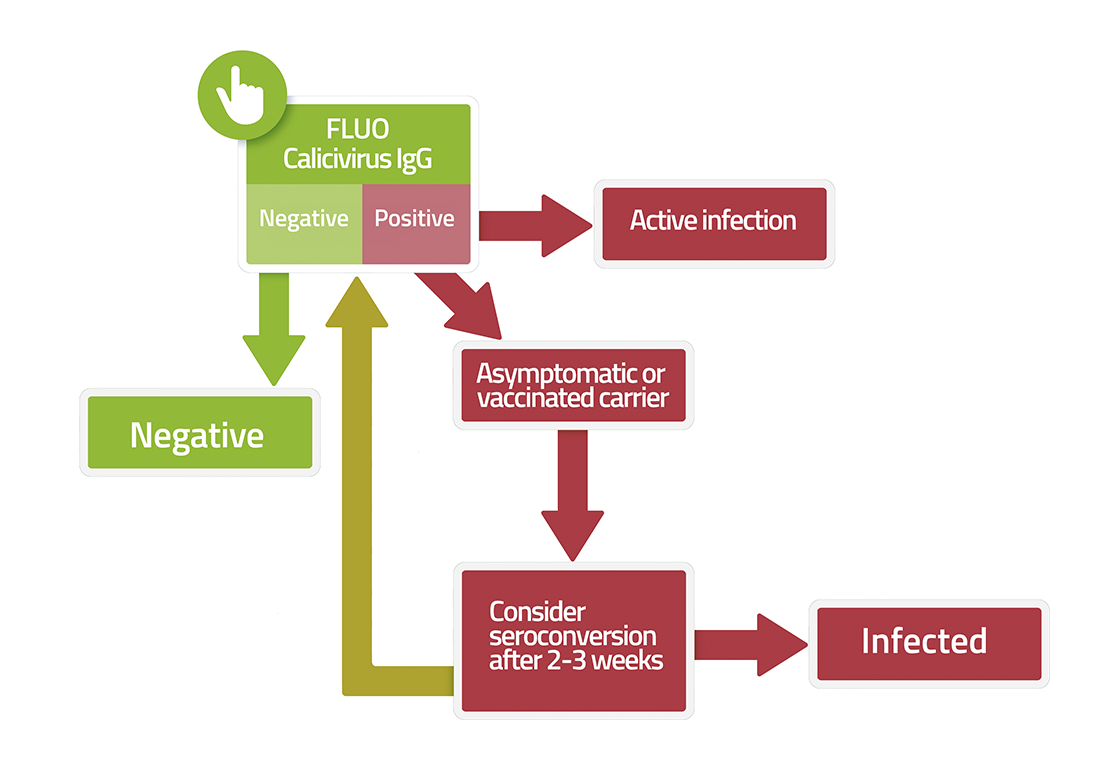

FLUO CALICIVIRUS
IFA kit for the detection of anti-Feline Calicivirus IgG antibodies
Fluo CALICIVIRUS is a test based on the immunofluorescence technique for the detection of IgG antibodies to Feline Calicivirus (FCV) in serum or plasma samples of cats.
Feline calicivirus (FCV) is one of the main causative agents of respiratory infections in cats and is commonly associated with oral ulcers, sneezing, and nasal discharge.
The latest knowledge in molecular virology has highlighted FCV as an extremely dynamic virus from an evolutionary perspective. Its high genetic variability, ability to rapidly adapt to the host, and interaction with the immune system explain the remarkable heterogeneity of clinical manifestations, which can range from mild, self-limited forms to severe systemic syndromes.
1.The role of the JAM-A receptor in cellular infection
FCV entry into target cells occurs through binding to Junctional Adhesion Molecule-A (JAM-A), a protein present on the surface of numerous epithelial cells and involved in maintaining the integrity of intercellular junctions. Experimental studies suggest that this interaction may also contribute to altering the organization of cell junctions, favoring increased mucosal permeability and facilitating the spread of the virus into tissues. Subsequent viral replication causes the death of infected cells and contributes to the formation of characteristic ulcerative lesions in the oral cavity.
2.Hypervirulent systemic forms (Virulent Systemic Feline Calicivirus)
One of the most significant developments in understanding the pathogenesis of FCV is the identification of highly virulent strains, termed Virulent Systemic Feline Calicivirus (VS-FCV). These strains, described in several countries in recent years, are responsible for much more severe clinical forms than classic respiratory calicivirus. In addition to the oral and respiratory mucosa, VS-FCV strains demonstrate a greater capacity to spread to numerous tissues and to involve endothelial cells, macrophages, and other systemic tissues. The resulting inflammatory response can cause vasculitis, diffuse edema, liver necrosis, coagulation disorders, and multiorgan failure.
These forms, fortunately uncommon, are associated with high mortality and require prompt clinical recognition.
3.High genetic variability and quasispecies formation
One of the most important biological characteristics of FCV is the remarkable variability of its genome.
- The enzyme responsible for viral RNA replication (RNA-dependent RNA polymerase) lacks effective error-correction mechanisms, leading to the continuous emergence of new genetic variants. Numerous closely related variants, called quasispecies, can coexist within the same infected animal. This continuous evolution allows the virus to rapidly adapt to selective pressures exerted by the immune system and is one of the main reasons for the persistence of the infection in some individuals. High antigenic variability also constitutes a major challenge in the development of vaccines capable of offering broad protection against all circulating strains.
4.The Role of FCV in Feline Chronic Gingivostomatitis
Feline chronic gingivostomatitis (FCGS) is a serious inflammatory disease of the oral cavity characterized by a marked local immune response. FCV is frequently isolated in cats with FCGS, but current evidence indicates that the disease is multifactorial, including immune-related, and cannot be attributed solely to the presence of the virus.
- In FCGS, calicivirus is considered one of the possible factors contributing to the maintenance of chronic antigenic stimulation. At the same time, numerous studies have documented alterations in the immune response, characterized by an imbalance between different lymphocyte populations (reduction in cytotoxic CD8+ T lymphocytes and uncontrolled hyperactivation of B lymphocytes) and persistent activation of the mucosal immune system. Other factors may also contribute to the pathogenesis of the disease, including dental bacterial biofilm, individual predisposition, alterations in the immune response, and the possible involvement of other infectious agents.
Bibliography
- Coyne, K. P., et al. (2006) Lethal outbreak of disease associated with feline calicivirus infection in cats. Veterinary Record, 158(16), 544-550.
- Harley, R., et al. (1999) Cytokine mRNA expression in lesions in cats with chronic gingivostomatitis. Clinical and Diagnostic Laboratory Immunology, 6(4), 471-478.
- Makino, A., et al. (2006) Junctional adhesion molecule 1 is a functional receptor for feline calicivirus. Journal of Virology, 80(9), 4482-4490.
- Pesavento, P. A., et al. (2004) Pathologic, immunohistochemical, and electron microscopic findings in naturally occurring virulent systemic feline calicivirus infection in cats. Veterinary Pathology, 41(3):257-63
- Radford, A. D., et al. (1997) The use of sequence analysis of a feline calicivirus (FCV) hypervariable region in the epidemiological investigation of FCV related disease and vaccine failures. Vaccine, 5(12-13):1451-1458.
- Radford, A. D., et al. (2007) Feline caliciviruses. Veterinary Research, 38(2), 319-335.
- Stuart, A. D., & Brown, T. D. (2006) Entry of feline calicivirus is dependent on clathrin-mediated endocytosis and acidification in endosomes. Journal of Virology, 80(15):7500-7509.
- Vapniarsky, N., et al. (2020) Histological, immunological, and genetic analysis of feline chronic gingivostomatitis. Front Vet Sci. 7:310.